
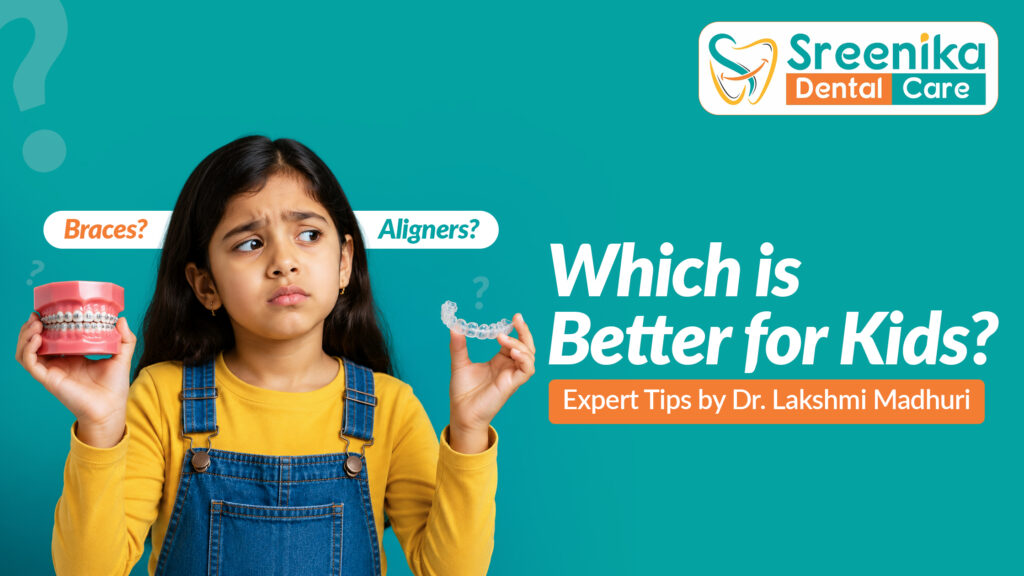
As parents, we all want our children to grow up with healthy, confident smiles. However, when teeth begin to appear crowded, crooked, or uneven, many parents find themselves asking an important question: Should my child get aligners or braces?
With modern orthodontic options available today, choosing the right treatment can feel overwhelming.
While traditional braces have been trusted for decades, clear aligners are becoming increasingly popular among children and teenagers because of their convenience and discreet appearance.
The truth is that there is no one-size-fits-all answer. The best treatment depends on your child’s age, dental condition, jaw development, lifestyle, and treatment goals.
If you are researching aligners or braces, understanding the differences between these options can help you make an informed decision for your child’s long-term oral health.
At Sreenika Dental Care, Attapur, Dr. Lakshmi Madhuri helps parents choose orthodontic solutions that support healthy dental development while helping children stay comfortable throughout the treatment process.
Why Orthodontic Treatment Matters for Children
Many parents assume orthodontic treatment is mainly for improving appearance. While a straight smile certainly boosts confidence, orthodontics also plays an important role in oral health.
Properly aligned teeth can help:
- Improve chewing efficiency
- Reduce the risk of tooth decay
- Make brushing and flossing easier
- Support healthy jaw growth
- Improve speech development
- Prevent uneven wear of teeth
Addressing orthodontic concerns at the right stage can reduce the likelihood of more complex dental problems in the future.
Understanding Braces
Traditional braces use metal or ceramic brackets attached to the teeth. These brackets are connected by wires that gradually move teeth into their desired positions.
Braces have been used successfully for decades and remain one of the most effective orthodontic solutions for correcting complex alignment issues.
Parents looking for reliable treatment often explore options for braces in Attapur when their child requires correction for moderate to severe orthodontic problems.
Advantages of Braces
- Suitable for complex dental issues
- Effective for severe crowding
- Can correct bite problems
- Constant treatment progress
- No risk of forgetting to wear them
Considerations
- Visible appearance
- Extra care needed while eating
- More attention required for oral hygiene
- Mild discomfort after adjustments
Despite these factors, braces remain highly effective for many children.
Understanding Clear Aligners
Clear aligners are transparent, removable trays custom-designed to gradually shift teeth into proper alignment.
Unlike braces, aligners do not use brackets or wires. Instead, children wear a series of customized trays that are changed periodically according to the treatment plan.
Many parents considering modern orthodontic solutions explore aligners in Attapur because of their aesthetic and convenience benefits.
Advantages of Aligners
- Nearly invisible appearance
- Removable during meals
- Easier brushing and flossing
- No metal brackets or wires
- Generally more comfortable
Considerations
- Requires discipline and consistent wear
- Not suitable for all complex cases
- Trays can be misplaced
- Success depends on patient compliance
Aligners can be an excellent option for responsible children who can follow wearing instructions carefully.
Aligners vs Braces: What Is the Main Difference?
Although both treatments aim to straighten teeth and improve oral health, they work differently.
Appearance
Aligners are transparent and less noticeable, making them popular among older children and teenagers.
Braces are visible but highly effective for a wide range of orthodontic concerns.
Comfort
Aligners generally provide a smoother experience because there are no brackets or wires that may irritate the cheeks and gums.
Braces may cause temporary soreness after adjustments.
Oral Hygiene
Aligners can be removed during brushing and flossing, making oral hygiene easier.
Braces require additional care to clean around brackets and wires.
Treatment Complexity
Braces can handle both simple and complex orthodontic issues.
Aligners are often ideal for mild to moderate alignment concerns.
Compliance
Braces stay on continuously, ensuring treatment progresses as planned.
Aligners require children to wear them for the recommended number of hours every day.
Which Option Is Better for Younger Children?
For younger children whose jaws and teeth are still actively developing, braces or growth-guidance appliances are often recommended.
This is because younger children may not consistently wear removable aligners as instructed.
In many cases, early orthodontic intervention focuses on:
- Guiding jaw development
- Creating space for permanent teeth
- Correcting bite issues
- Preventing worsening alignment problems
Regular evaluations at a kids dental clinic in Attapur can help determine the most suitable treatment approach based on a child’s stage of development.
Signs Your Child May Need Orthodontic Treatment
Parents should watch for signs that could indicate orthodontic concerns.
These may include:
- Crooked or crowded teeth
- Difficulty chewing food
- Frequent mouth breathing
- Thumb-sucking habits beyond early childhood
- Teeth that do not meet properly
- Speech difficulties
- Jaw shifting during chewing
- Early or delayed loss of baby teeth
Early identification often leads to simpler and more effective treatment.
When Should Children Have Their First Orthodontic Evaluation?
Most dental experts recommend an orthodontic evaluation around age 7.
This does not necessarily mean treatment will begin immediately. Instead, the dentist monitors:
- Jaw growth patterns
- Tooth eruption
- Bite development
- Space availability for permanent teeth
Early assessments allow orthodontic concerns to be addressed before they become more severe.
How Dr. Lakshmi Madhuri Helps Parents Choose the Right Option
Every child has unique dental needs. What works well for one child may not be suitable for another.
At Sreenika Dental Care, treatment recommendations are based on:
- Age
- Dental development
- Severity of alignment issues
- Jaw growth patterns
- Lifestyle factors
- Oral hygiene habits
Rather than recommending treatment based solely on appearance, the focus remains on achieving long-term oral health and proper function.
Parents searching for a trusted dentist near Attapur often seek guidance on whether braces or aligners will provide the best results for their child’s specific condition.
What Happens During the Consultation?
The first orthodontic consultation is simple and child-friendly.
The appointment may include:
- Clinical examination
- Dental photographs
- X-rays if required
- Bite assessment
- Growth evaluation
- Discussion with parents
Based on these findings, a personalized treatment plan is created.
Not every child requires immediate treatment. In some cases, regular monitoring may be the best approach.
Benefits of Choosing Treatment at the Right Time
Starting orthodontic care at the appropriate stage offers several advantages.
These include:
- Better treatment outcomes
- Improved jaw development
- Reduced need for extractions
- Easier tooth movement
- Enhanced oral hygiene
- Lower risk of future complications
Timely intervention often results in shorter and more predictable treatment.
Why Choosing the Right Pediatric Orthodontic Care Matters
Children need a different approach to dental care than adults.
At Sreenika Dental Care, the focus is on creating a positive experience through:
- Gentle communication
- Child-friendly environment
- Personalized treatment plans
- Preventive dental care
- Growth-guided orthodontics
This supportive approach helps children feel comfortable and confident throughout their orthodontic journey.
FAQs
1. What age is best for braces or aligners?
Most children should have an orthodontic evaluation around age 7. The ideal treatment age varies depending on individual dental development.
2. Are aligners better than braces for kids?
Not always. Aligners work well for some children, while braces may be more effective for complex orthodontic issues.
3. How long does orthodontic treatment take?
Treatment duration varies but generally ranges from 12 to 24 months depending on the severity of the condition.
4. Do braces hurt children?
Braces may cause mild discomfort after adjustments, but the sensation usually subsides within a few days.
5. How do I know if my child needs orthodontic treatment?
Signs such as crowded teeth, bite issues, difficulty chewing, or jaw alignment problems may indicate the need for an orthodontic evaluation.
Making the Right Orthodontic Choice for Your Child
When it comes to choosing between aligners and braces for children, the right answer depends on your child’s unique dental needs. Both options can deliver excellent results when recommended and monitored by an experienced dental professional.
The most important step is not deciding between braces or aligners it is ensuring your child receives an orthodontic evaluation at the right age.
At Sreenika Dental Care, Dr. Lakshmi Madhuri helps parents understand every available option and guides children toward healthier, more confident smiles through personalized orthodontic care.
If you’re concerned about your child’s teeth alignment or jaw development, an early consultation can provide the clarity and reassurance you need.
📞 Call or WhatsApp: 091827 11994
🌐 https://sreenikadentalcare.com/
📍 Attapur, Hyderabad