
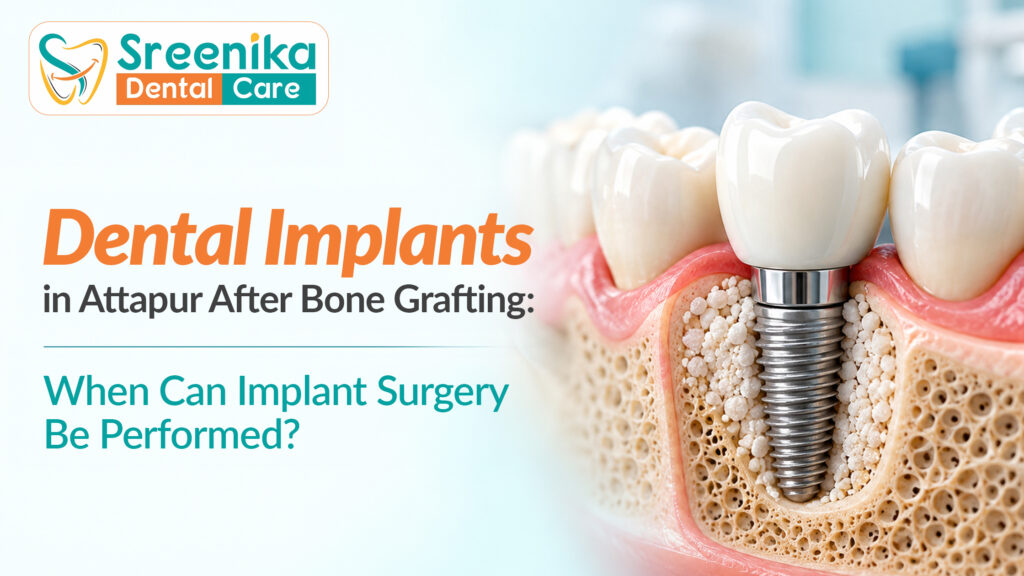
Losing a tooth can affect more than your smile. Over time, the jawbone beneath a missing tooth may become thinner or lose height, making it difficult to place a dental implant securely. Fortunately, bone grafting can help rebuild the affected area and create a stronger foundation for tooth replacement.
For patients considering dental implants in Attapur, the timing of implant placement after bone grafting is an important part of treatment planning. Some patients can receive an implant during the same procedure as bone grafting, while others need several months for the graft to heal. The right approach depends on the amount of bone available, the type of graft used, and individual healing progress.
At Sreenika Dental Care, implant treatment is planned according to each patient’s oral health, bone condition, and long-term dental needs. Understanding the healing process can help you know what to expect before moving forward with treatment.
What Is Bone Grafting in Dental Implant Treatment?
Bone grafting is a dental procedure that adds bone material to an area where the jawbone has become too thin, too short, or insufficient to support an implant.
The jawbone naturally responds to tooth loss. When a tooth root is missing, the bone in that area may gradually shrink because it no longer receives the same stimulation from chewing. Gum disease, dental infections, injuries, and previous tooth extractions can also contribute to bone loss.
A dental implant needs adequate bone support to remain stable. If the available bone is insufficient, placing an implant without addressing the deficiency may increase the risk of complications.
During bone grafting, a dentist places suitable graft material in the affected area. Over time, the body remodels the area and develops new bone around the graft material.
The procedure may be recommended to:
- Increase the width or height of the jawbone.
- Rebuild bone lost after a tooth extraction.
- Improve support for a future dental implant.
- Preserve the shape of the jaw following tooth loss.
- Address bone defects caused by gum disease or injury.
Not every patient requires grafting before receiving an implant. A clinical examination and appropriate imaging help determine whether additional bone support is necessary.
When Can Dental Implant Surgery Be Performed After Bone Grafting?
There is no single waiting period that applies to every patient. The time between bone grafting and implant placement depends on the size of the bone defect, the grafting technique, the location of the missing tooth, and the patient’s healing response.
In many cases, implant surgery can be performed after approximately three to six months of healing. Larger grafts or more complex procedures may require six to nine months or longer.
1. Small Bone Grafts
Small bone defects may heal relatively quickly, particularly when the graft is performed alongside a tooth extraction or implant placement.
If the remaining jawbone provides adequate initial stability, the dentist may sometimes place the implant at the same appointment as the graft. This is called simultaneous bone grafting and implant placement.
However, immediate placement is not suitable for every patient. The implant must have sufficient support, and the surgical site must be appropriate for this approach.
2. Moderate Bone Grafting
Patients who need additional bone width or height may have to wait around three to six months before implant placement.
During this period, the grafted area undergoes healing and remodeling. The dentist may recommend a follow-up examination or scan to evaluate whether the bone has developed sufficient volume and stability.
The implant is placed once the dentist confirms that the grafted bone is ready.
3. Extensive Bone Grafting
Significant bone loss may require a larger graft or a more complex procedure, such as a sinus lift in the upper back jaw.
In these situations, healing may take six to nine months or longer, depending on the technique and the patient’s condition.
Patients should not assume that reaching a particular month automatically means they are ready for surgery. The decision must be based on clinical assessment rather than time alone.
Can Dental Implants Be Placed on the Same Day as Bone Grafting?
Yes, in selected cases, bone grafting and implant placement can be performed during the same surgical appointment.
This approach may be possible when enough natural bone remains to stabilize the implant and the bone defect can be managed with graft material around the implant.
Potential advantages include fewer surgical appointments and a shorter overall treatment timeline.
However, simultaneous placement may not be appropriate when there is extensive bone loss, inadequate implant stability, active infection, or other conditions that could affect healing.
When the available bone cannot provide sufficient support, the dentist may recommend completing the graft first and placing the implant after the area has healed.
The safest treatment plan is the one that provides adequate support for long-term implant stability rather than simply aiming to reduce the waiting period.
What Factors Affect Healing After Bone Grafting?
Healing time differs from person to person. Several factors can influence how quickly the grafted area becomes suitable for implant placement.
Amount of Bone Loss
A small defect generally requires less reconstruction than a large area with substantial loss of bone height or width. Larger grafts may need additional time to integrate with the surrounding bone.
Type of Graft Material
Bone grafts may use material obtained from the patient’s own body, processed donor bone, animal-derived material, or synthetic substitutes. The material and technique influence how the graft integrates and remodels.
Gum and Oral Health
Healthy gums provide a better environment for healing. Active gum disease, untreated dental infections, or poor oral hygiene may interfere with recovery and need to be addressed.
General Health
Conditions that affect healing, certain medications, and poorly controlled diabetes can influence recovery. Your dentist may review your medical history and coordinate with your physician when necessary.
Smoking and Tobacco Use
Smoking can impair blood supply and interfere with wound healing. Avoiding tobacco before and after surgery, according to your dentist’s instructions, can help support recovery.
How Do Dentists Know When the Graft Is Ready?
The completion of the waiting period does not automatically confirm that an implant can be placed. Your dentist must evaluate the grafted area before proceeding.
The assessment may include the following steps:
Clinical examination: The dentist checks the gums, surgical site, and surrounding tissues for signs of healing, tenderness, swelling, or infection.
Dental imaging: X-rays or a three-dimensional CBCT scan may be used to evaluate bone volume, the grafted region, and nearby anatomical structures.
Bone stability assessment: The dentist determines whether the available bone can provide the support needed for implant placement.
Review of medical history: Conditions, medications, and habits that may affect healing are considered before surgery is scheduled.
Once the area is considered suitable, the dentist can plan the implant’s position and determine the next steps in restoring the missing tooth.
What Happens After Dental Implant Placement?
Bone grafting is only one stage of treatment. After the implant is placed, another healing period is usually required for the implant to integrate with the jawbone. This process is called osseointegration.
The implant may need approximately three to six months to integrate, although the exact duration varies according to the location, stability, bone quality, and individual healing.
During this stage, your dentist may recommend a temporary tooth or another suitable replacement option, depending on the surgical site and treatment plan.
Once integration is satisfactory, the dentist attaches the abutment and final crown or another appropriate restoration.
The total treatment period can therefore extend over several months when grafting and implant placement are performed as separate procedures.
Following postoperative instructions, maintaining good oral hygiene, and attending scheduled reviews are essential throughout the process.
Why Choose a Specialist for Implant Treatment in Attapur?
Successful implant treatment requires careful assessment of the jawbone, gums, bite, and surrounding anatomical structures. When bone grafting is involved, treatment planning becomes especially important because both the graft and the implant need appropriate support.
Before proceeding with treatment, consider the dentist’s qualifications, experience with implant procedures, availability of suitable diagnostic imaging, and approach to follow-up care.
At Sreenika Dental Care, Dr. B. Harish Reddy, an MDS-qualified periodontist and implantologist, provides care for patients with implant-related needs. A detailed assessment can help determine whether bone grafting is required, how long healing may take, and which treatment sequence is appropriate.
Patients should also receive clear information about the procedure, expected recovery, possible risks, treatment costs, and available tooth replacement options before making a decision.
How Can You Support Recovery After Bone Grafting?
Following your dentist’s instructions can help protect the surgical site and support healing.
- Maintain gentle oral hygiene:Clean your teeth as directed while avoiding unnecessary disturbance to the grafted area.
- Choose suitable foods:Soft foods may be recommended during the initial recovery period. Avoid hard, crunchy, or very hot foods if advised.
- Avoid smoking:Tobacco use can interfere with healing and increase the risk of complications.
- Take prescribed medication correctly:Follow your dentist’s instructions for pain relief, antibiotics, or other prescribed medicines.
- Attend follow-up appointments:Regular reviews help your dentist monitor healing and identify potential concerns early.
- Report unusual symptoms:Increasing pain, worsening swelling, fever, persistent bleeding, or discharge should be reported promptly.
Do not rush into the next stage of treatment because the surgical site feels comfortable. The bone may need additional time to heal even when symptoms have subsided.
Frequently Asked Questions
1. How many months should I wait for dental implants after bone grafting?
Many patients wait around three to six months, while extensive grafting may require six to nine months or longer. Your dentist will assess the graft’s healing and bone stability before recommending implant placement.
2. Is bone grafting always necessary before dental implant surgery?
No. Patients with sufficient bone volume and quality may be able to receive an implant without grafting. The need for additional bone depends on the condition of the jawbone and the planned implant position.
3. Can bone grafting and dental implant surgery be performed together?
Yes, in selected cases. Simultaneous treatment may be possible when sufficient natural bone is available to stabilise the implant. Extensive bone loss or inadequate stability may require a separate grafting procedure followed by a healing period.
4. Is bone grafting painful?
Local anaesthesia is generally used during the procedure to manage pain. Some swelling, tenderness, or discomfort may occur afterward, and these symptoms are usually managed with appropriate medication and postoperative care. Recovery varies between patients.
5. What happens if the bone graft does not heal properly?
If healing is delayed or the graft develops complications, implant placement may need to be postponed. Your dentist will assess the affected area and recommend appropriate management before proceeding with treatment.
Plan Your Dental Implant Treatment at Sreenika Dental Care
Replacing a missing tooth after bone grafting requires patience, careful planning, and appropriate follow-up. Although Some patients can receive an implant during the bone grafting procedure, others benefit from allowing the reconstructed bone to heal before implant placement.
If you are exploring tooth replacement options after bone grafting, Sreenika Dental Care can help you understand the available treatments and expected healing timeline.
Consult our dental team for an assessment of your jawbone and implant requirements. The dentist can explain whether bone grafting is needed, when surgery may be appropriate, and how the final restoration will be planned.
Call Sreenika Dental Care at 91827 11994 to book your consultation.